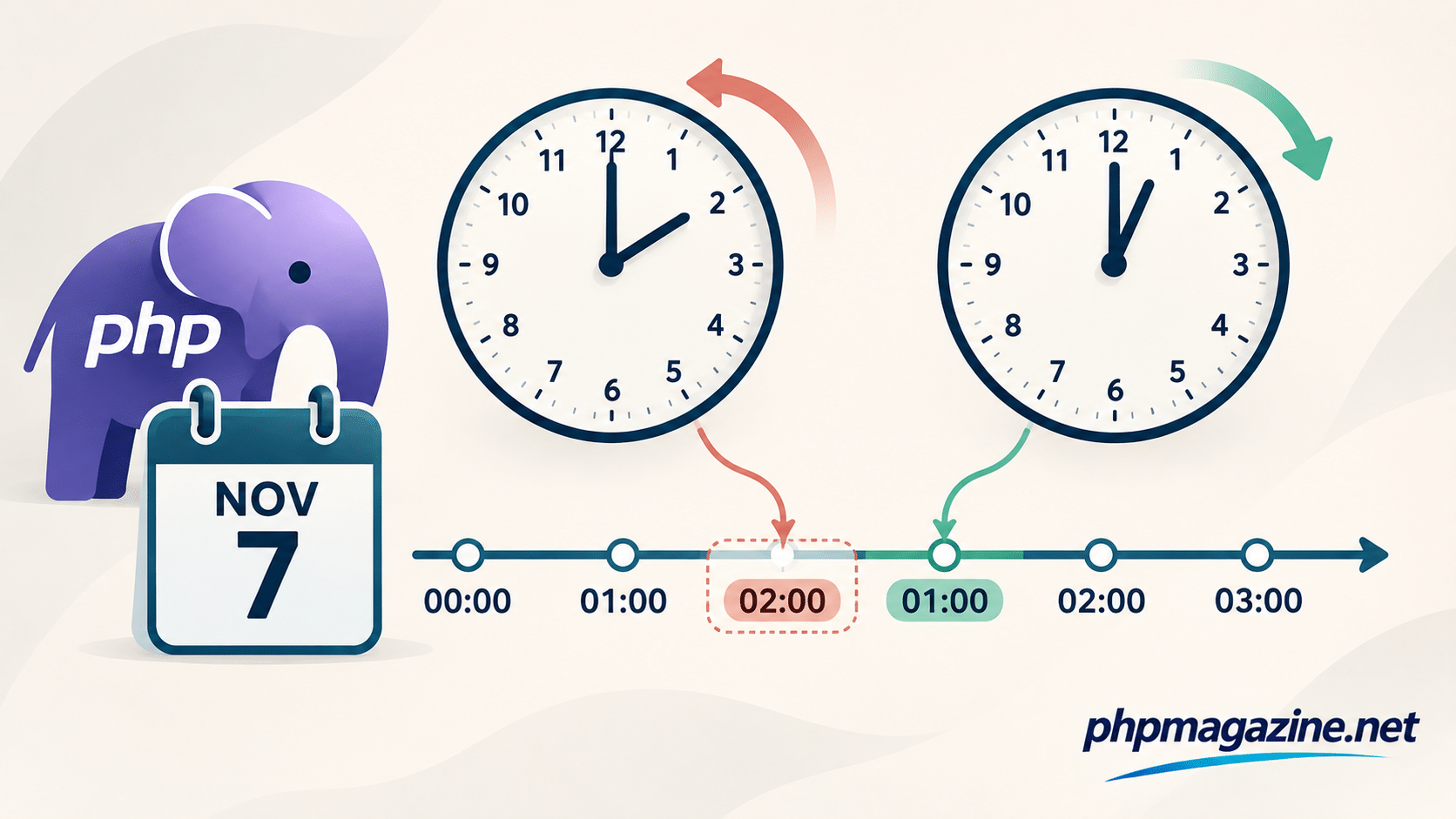
A timestamp looks precise until it is expressed as a local date and time without an offset. In many regions, daylight-saving transitions mean that a local clock can skip an hour in spring or repeat an hour in autumn. A value such as 01:30 may identify two different instants, while another local time may never occur.
For PHP applications that schedule appointments, execute recurring jobs or calculate deadlines, this is not an obscure calendar problem. It is a data-modeling problem. The application must distinguish an instant on the global timeline from the local civil time used by people and institutions.
Two clocks, two meanings
An instant is a unique point in time, representable as a Unix timestamp or an ISO 8601 timestamp with an offset. A local civil time is a date and clock reading interpreted according to the rules of a named time zone.
Those rules can change over time. The IANA time-zone database records historical and current rules for regions such as America/Toronto, Europe/Paris and Asia/Tokyo. A numeric UTC offset is not equivalent to a named time zone: it does not contain the rules needed to interpret future or historical transitions.
For example, on November 1, 2026, the clock in Toronto moves backward from daylight time to standard time. Local 01:30 occurs twice: once at UTC−04:00 and once at UTC−05:00. The two readings are separated by a real hour.
PHP can represent both instants
PHP’s DateTimeImmutable class can preserve a specific instant and convert its presentation to a named time zone. The following example constructs two distinct UTC instants and displays them in Toronto.
setTimezone($toronto)
        ->format('Y-m-d H:i:s P T'), PHP_EOL;
}
The two lines share the same local date and clock reading but have different offsets. This is why storing only the string 2026-11-01 01:30:00 loses essential information.
Parsing success does not guarantee a valid appointment
DateTimeImmutable::createFromFormat() is useful for controlled input parsing, but developers must understand its normalization behavior. PHP’s date/time parser can accept out-of-range values and normalize them, while recording warnings. Applications that require exact user input should inspect parsing errors and warnings and verify a round trip to the original representation.
 0
            || $errors['error_count'] > 0
        ))
        || $value->format('Y-m-d H:i') !== $input
    ) {
        throw new InvalidArgumentException(
            'Invalid or normalized local date/time.'
        );
    }

    return $value;
}
This function rejects malformed input and values that do not survive normalization unchanged. It does not resolve every ambiguity. During an autumn transition, both possible instants can format back to the same local string. A round-trip comparison alone cannot distinguish them.
The missing-hour problem
During the spring transition, some local clock readings do not exist. In Toronto, for example, the clock jumps forward on March 8, 2026. A scheduling system should not silently transform a requested nonexistent appointment time into a different one without a documented business rule.
One reasonable policy is to reject nonexistent local times and ask the user to select another time. Another may be appropriate for recurring operational jobs, such as running a task at the next valid local time. The correct choice depends on the domain.
Detecting an ambiguous local time
A robust scheduling service can inspect time-zone transitions around a proposed local time and determine whether more than one UTC instant maps to it. The following function uses candidate offsets from the relevant transition window and checks which instants round-trip to the requested local value.
format('Y-m-d H:i') !== $local
    ) {
        throw new InvalidArgumentException('Invalid input.');
    }

    $wallTimestamp = $wall->getTimestamp();

    $transitions = $zone->getTransitions(
        $wallTimestamp - 172800,
        $wallTimestamp + 172800
    );

    if ($transitions === false) {
        throw new RuntimeException(
            'Named time zone required.'
        );
    }

    $matches = [];

    foreach ($transitions as $transition) {
        $offset = $transition['offset'];
        $candidate = $wallTimestamp - $offset;

        $instant = (new DateTimeImmutable('@' . $candidate))
            ->setTimezone($zone);

        if ($instant->format('Y-m-d H:i') === $local) {
            $matches[$candidate] = $instant;
        }
    }

    ksort($matches);

    return array_values($matches);
}

$zone = new DateTimeZone('America/Toronto');

foreach (
    matchingInstants('2026-11-01 01:30', $zone)
    as $instant
) {
    echo $instant->format('c'), PHP_EOL;
}
For this transition, the function identifies both valid instants. A result containing zero candidates indicates a nonexistent local time; one candidate identifies an unambiguous time; two candidates identify a repeated clock reading.
This example is intended for named IANA time zones and ordinary modern scheduling ranges. Production implementations should test historical transitions, unusual offset changes, input precision and the time-zone database version deployed with PHP.
A scheduling model needs more than UTC
Storing confirmed appointment instants in UTC is a sensible practice, but UTC alone is not sufficient for every business requirement. An organization may define its operating hours as 09:00–17:00 local time. Those hours are recurring civil-time rules, not fixed UTC intervals.
A scheduling system may therefore need to retain the named time zone, local operating rules, confirmed UTC instants and the offset selected when an ambiguous time was resolved. Future appointments may also be affected by changes to government time-zone rules.
Recurring tasks introduce another decision. Should a job run every 24 elapsed hours, or every day at 09:00 local time? Those are different schedules across daylight-saving transitions.
Test the calendar boundaries
Useful tests include the hour before a transition, the missing or repeated interval, the hour after the transition, a leap day and a date in a region that does not observe daylight saving time. Tests should use explicit zones and fixed dates rather than relying on the machine’s default time zone.
PHP provides capable date/time primitives. The architectural responsibility remains with the application: decide what a user’s local time means, reject ambiguity where necessary and preserve enough information to reconstruct the intended instant.
Related
php-datetimeimmutable-when-local-time-does-not-identify-a-unique-moment