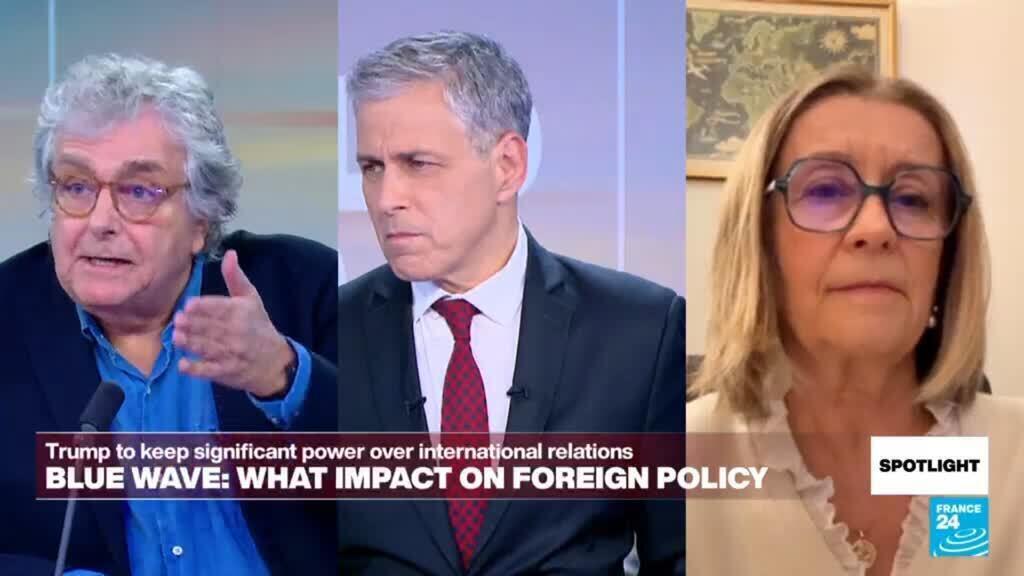

François Picard is pleased to welcome Craig Copetas, Greek-American author, international affairs columnist and editor at Türkiye Today and French Senator Hélène Conway-Mouret. “What you have is a tormented and unstable president who’s desperate for immortality.” With this arresting assessment, Copetas captures what he considers the defining paradox of Donald Trump’s presidency in the aftermath of the US midterm elections: a leader politically neutered at home but potentially emboldened on the international stage.
Copetas challenges the assumption that Democratic electoral gains necessarily herald a return to political stability or predictability in Washington’s relations with its allies. “He has no control, really, in the United States now, but he has a lot of leeway overseas,” he argues, suggesting that domestic weakness may intensify rather than diminish the risks associated with presidential decision-making abroad.
At the heart of his analysis is the possibility that Trump’s pursuit of historical significance could encourage a dramatic geopolitical bargain with China. Citing concerns expressed by foreign policy advisers in Washington, Copetas raises the prospect of Taiwan becoming a bargaining chip in negotiations with President Xi Jinping, describing such a possibility as a “Faustian bargain.” The warning is speculative, but it illustrates a broader anxiety about the vulnerability of longstanding security commitments to personalized diplomacy.
The roundtable extends beyond conventional geopolitics to the intersection of political power, corporate influence and economic dependence. Copetas predicts mounting scrutiny of Elon Musk’s relationship and complex dealings with the US government, while identifying potential opportunities for European competitors in satellite communications, artificial intelligence and aerospace. Conway-Mouret, meanwhile, emphasizes Europe’s strategic and economic weight, warning that the continent must not become “the playground of three major countries.”
Yet the final insight returns to the domestic economic grievances that shape American political behavior. From the industrial decline of Pennsylvania to the rising cost of living and the consequences of tariffs, Copetas argues that the electorate’s immediate concerns remain far removed from the strategic geopolitical calculations of Washington’s foreign policy establishment.
The result is an in-depth examination of the relationship between domestic political constraints, presidential ambition, and indulgence, and international instability. As Copetas concludes, “This is not over by a long shot. Watch your back.” His warning is less a prediction of any single crisis than a challenge to the comforting assumption that electoral setbacks necessarily produce geopolitical restraint.
period-of-uncertainty-trump-is-tormented-hes-unstoppable-and-hes-desperate-for-immortality-spotlight